Medical Coding

Medical Terminology for Medical Coders
Blog, Medical Coding

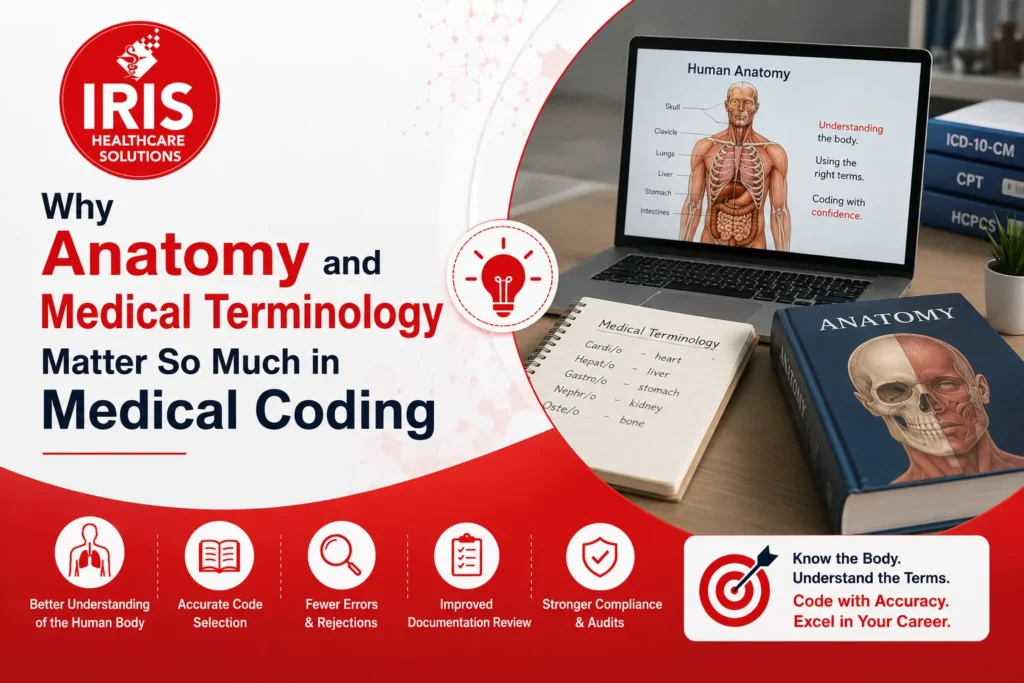
Why Anatomy and Medical Terminology Matter So Much in Medical Coding

Why Anatomy and Medical Terminology Matter So Much in Medical Coding Imagine receiving a medical record filled with terms like cholecystectomy, myocardial infarction, arthroscopy, or gastroesophageal reflux disease. If you don’t understand what these terms mean or which part of the body they relate to, accurate medical coding becomes extremely difficult. This is why anatomy and medical terminology are not just basic subjects for medical coders—they are the foundation of accurate coding. Whether you are a beginner planning to join a Medical Coding Course Hyderabad or preparing for CPC certification, having a strong understanding of the human body and medical language can make a major difference in your coding career. At IRIS Healthcare Solutions, we focus on building these fundamentals so students don’t simply memorize codes but understand the clinical information behind them. What Is Anatomy and Why Does a Medical Coder Need It? Anatomy is the study of the structure of the human body. It helps you understand organs, tissues, body systems, and how different parts of the body are connected. A medical coder may come across documentation involving: Cardiovascular system Respiratory system Digestive system Musculoskeletal system Nervous system Urinary system Reproductive system Endocrine system Integumentary system A coder doesn’t need to become a doctor, but they need enough anatomical knowledge to understand the documentation and identify the correct diagnosis or procedure code. For example, if a physician documents a procedure involving the right femur, a coder should understand where the femur is located and recognize the difference between the femur and other bones of the lower extremity. Without this knowledge, even a small misunderstanding can lead to an incorrect code. Why Medical Terminology Is Equally Important Medical terminology is essentially the language used by healthcare professionals. Doctors, nurses, physicians, hospitals, and healthcare organizations use specialized terminology to describe diseases, symptoms, procedures, treatments, and body parts. Medical coders regularly encounter terms that may look complicated at first. For example: Hepat- relates to the liver Cardi- relates to the heart Nephr- relates to the kidney Gastr- relates to the stomach Arthr- relates to joints Derm- relates to the skin Oste- relates to bone Once you understand common medical word roots, prefixes, and suffixes, unfamiliar terminology becomes much easier to interpret. That’s an important skill for anyone pursuing Medical Coding Training Hyderabad. Anatomy Helps You Understand the Clinical Picture Medical coding isn’t simply about finding a word in a coding book and selecting a number. A coder needs to understand the clinical information documented by the healthcare provider. Consider a simple example. A medical record may mention: “Patient presented with pain in the right knee and underwent arthroscopic surgery.” A coder who understands anatomy knows that the knee is a joint and can better understand the relationship between the documented condition and the procedure. This clinical understanding helps coders review documentation more confidently and select codes according to the applicable coding guidelines. Medical Terminology Makes ICD-10-CM Coding Easier ICD-10-CM coding involves assigning diagnosis codes based on documented medical conditions. To choose the appropriate code, coders often need to identify important details such as: The specific condition Anatomical location Laterality Acute or chronic nature Underlying cause Complications Associated conditions Encounter details, when applicable Understanding medical terminology makes it easier to identify these details within clinical documentation. For students preparing for CPC Certification Training in Hyderabad, developing this skill early can make ICD-10-CM concepts much easier to understand. Anatomy Is Especially Important for CPT Coding Anatomy becomes particularly valuable when learning CPT coding. CPT codes describe medical procedures and services, and many procedures are organized according to anatomical areas or body systems. For example, when studying surgical procedures, a coder may need to understand: Which organ or body structure was treated The location of the procedure Whether the procedure was performed on one or multiple sites What type of procedure was performed Whether additional procedures were performed This is why anatomy is an important part of CPC exam preparation. A student who understands the anatomy behind a procedure will generally find it easier to interpret operative documentation than someone who relies entirely on memorization. Anatomy and Terminology Help Reduce Coding Errors Coding errors don’t always happen because a person doesn’t know a code. Sometimes the real problem is misunderstanding the documentation. For example, confusing two similar medical terms or misunderstanding an anatomical structure can result in selecting the wrong diagnosis or procedure code. Strong fundamentals can help reduce errors such as: Selecting the wrong body site Missing laterality Misinterpreting a diagnosis Confusing similar medical terms Selecting an incorrect procedure code Missing important documentation details Misunderstanding clinical abbreviations Accuracy is one of the most important skills for anyone entering the medical coding profession. Do You Need to Memorize Every Anatomical Term? No. This is one of the biggest concerns beginners have when starting a Medical Coding Course in Hyderabad. You don’t need to memorize every anatomical structure in the human body. Instead, focus on understanding the major body systems and commonly used terminology. Start with: 1. Major Body Systems Understand the basic function and major organs of each system. 2. Anatomical Direction Learn terms such as: Superior Inferior Anterior Posterior Medial Lateral Proximal Distal 3. Common Medical Word Parts Learn frequently used prefixes, roots, and suffixes. 4. Common Diseases and Conditions Understand common diagnoses that appear frequently in medical records. 5. Common Procedures Learn what common diagnostic and surgical procedures actually involve. This approach is much more effective than trying to memorize hundreds of disconnected terms. Anatomy and Medical Terminology in CPC Preparation The CPC certification exam requires more than simply memorizing medical codes. Students need to understand coding concepts, medical terminology, anatomy, guidelines, and clinical documentation. That’s why anatomy and medical terminology should be studied alongside: ICD-10-CM CPT HCPCS Level II Medical coding guidelines E/M coding Surgery coding Anesthesia coding Radiology coding Pathology and laboratory coding Modifiers Compliance concepts For students looking for CPC Certification Training in Hyderabad, choosing a program that covers these fundamentals can provide a stronger foundation for exam
Medical Coding Jobs
Blog, Medical Coding

How AI Is Changing Medical Coding Jobs, Training and Career Opportunities

How AI Is Changing Medical Coding Jobs, Training and Career Opportunities AI is not waiting for the future of medical coding—it is already becoming part of the coder’s everyday workflow. But does that mean medical coders will lose their jobs? Not necessarily. The bigger change is in what a skilled coder needs to know. Healthcare organizations are increasingly using technology to manage medical records, claims, documentation, and coding workflows. Artificial intelligence can help identify clinical information, suggest codes, organize documentation, and reduce repetitive tasks. For aspiring medical coders, this change creates an important opportunity: learn coding fundamentals first, then learn how to work effectively with technology. What Is AI in Medical Coding? Artificial intelligence in medical coding refers to technology that can analyze healthcare documentation and assist with coding-related tasks. AI-powered and computer-assisted coding systems may help identify: Diagnoses Procedures Medical terminology Relevant documentation Potential ICD-10-CM codes CPT and HCPCS code possibilities Missing or inconsistent information However, an AI system does not automatically understand every clinical situation correctly. A professional coder still needs to review the documentation, apply coding guidelines, and determine whether a code is actually supported. This is where human expertise remains important. Will AI Replace Medical Coders? This is probably the biggest question among students considering a Medical Coding Course in Hyderabad. The simple answer is that AI is more likely to change the coder’s role than completely eliminate it. Medical coding involves interpretation, documentation review, coding guidelines, compliance requirements, and clinical understanding. Complex cases may require a level of judgment that cannot be handled simply by matching keywords with codes. Instead of spending all their time on repetitive searches, coders may increasingly use technology to handle routine tasks while focusing more on: Reviewing AI-generated suggestions Validating codes Understanding clinical documentation Resolving coding issues Applying coding guidelines Handling complex cases Supporting audits and quality control The future may therefore favor coders who know both coding and technology. How AI Can Make Medical Coding More Efficient One major advantage of AI is its ability to process large amounts of information quickly. For example, AI-assisted systems may help identify relevant information from lengthy medical documentation. This can reduce the amount of manual searching required by coders. Technology can potentially help with: Faster Code Identification AI systems can analyze documentation and suggest potential codes, giving coders a starting point for their review. Reduced Repetitive Work Routine tasks can be automated, allowing coders to spend more time on cases that require human judgment. Documentation Review Technology can highlight terms, diagnoses, procedures, or documentation elements that may require additional attention. Quality Checks Automated systems can help identify possible inconsistencies or coding issues before claims or records move to the next stage. The important point is that AI assistance does not remove the need for coding knowledge. In fact, understanding coding principles becomes even more important when reviewing automated suggestions. Why Medical Coding Fundamentals Still Matter Imagine an AI system suggests a code based on information in a medical record. How will you know whether the suggestion is correct? You need to understand the documentation. You need to know the coding guidelines. You need to understand anatomy and medical terminology. You need to know when a code is supported—and when it isn’t. This is why students looking for Medical Coding Training in Hyderabad should focus on developing strong fundamentals before worrying about advanced technology. A good training program should cover: Anatomy and Physiology Medical Terminology ICD-10-CM CPT HCPCS Level II Coding Guidelines Modifiers Medical Documentation Practical Coding These skills provide the foundation for working confidently with both traditional and technology-assisted coding systems. AI Is Changing Medical Coding Training Too The way students learn medical coding is also evolving. Earlier, training could focus heavily on learning codebooks and practicing manual code selection. Today, students also need to understand how technology is used in modern healthcare environments. A future-ready Medical Coding Course in Hyderabad should help learners develop: Coding Knowledge + Clinical Understanding + Technology Awareness Students should learn how to: Read medical documentation Interpret clinical information Apply coding guidelines Use coding references Understand encoder software Review technology-generated code suggestions Identify documentation issues Maintain coding accuracy Technology should be treated as a tool—not a replacement for knowledge. The Growing Importance of CPC Certification As technology becomes more involved in healthcare coding, professional knowledge remains valuable. This is one reason many students choose CPC Certification Training in Hyderabad as part of their career preparation. CPC preparation helps learners develop knowledge in areas such as: ICD-10-CM coding CPT coding HCPCS coding Anatomy Medical terminology Evaluation and Management Modifiers Coding guidelines A certification can demonstrate that a candidate has developed a structured understanding of professional coding concepts. However, certification alone isn’t enough. Employers also value practical skills, accuracy, communication, adaptability, and the ability to work with technology. What Skills Will Future Medical Coders Need? The medical coder of the future will need a broader skill set than simply knowing how to find a code. 1. Strong Coding Knowledge A coder must understand ICD-10-CM, CPT, HCPCS, guidelines, and documentation requirements. 2. Clinical Reasoning Understanding the clinical meaning behind documentation helps coders make better decisions. 3. Technology Skills Coders should be comfortable using EHRs, encoders, CAC systems, and other healthcare technology. 4. Attention to Detail Even when AI is involved, coders need to identify errors and inconsistencies. 5. Communication Coders may need to communicate with auditors, providers, clinical documentation teams, and other departments. 6. Continuous Learning Technology and coding practices will continue to evolve. Successful coders need to keep learning throughout their careers. How AI May Create New Career Opportunities AI may also create opportunities for professionals who develop both coding and technology skills. As healthcare organizations adopt more automated systems, there may be greater demand for professionals who can work with technology while understanding medical coding. Potential career directions may include: Medical Coding Coding Quality Analyst Coding Auditor Clinical Documentation-related roles Risk Adjustment Coding HCC Coding Coding Compliance Revenue Cycle Management Healthcare Data-related roles The exact opportunities depend

Medical Coding Skills
Blog, Medical Coding

The New Medical Coder Skill Set: Coding + Technology + Clinical Reasoning

The New Medical Coder Skill Set: Coding + Technology + Clinical Reasoning A medical coder who only knows how to find a code may be able to start the job. But a coder who understands the code, the technology behind it, and the clinical story is prepared for where the profession is going. Medical coding is changing. The role of a coder is no longer limited to opening a codebook, finding a diagnosis, and assigning a code. Healthcare organizations are increasingly using electronic health records, coding software, computer-assisted coding, automation, and data-driven systems as part of their daily workflow. That doesn’t mean technology is replacing medical coders. Instead, it is changing what employers expect from skilled coders. Today’s successful medical coder needs a combination of coding knowledge, technology awareness, and clinical reasoning. What Does the Modern Medical Coder Need to Know? A strong medical coder should be comfortable working across three important areas: Coding + Technology + Clinical Reasoning These skills complement each other. Coding knowledge helps you select the appropriate codes. Technology helps you work efficiently. Clinical reasoning helps you understand what the documentation is actually saying. Let’s look at why each skill matters. 1. Strong Medical Coding Fundamentals Technology can make coding faster, but it cannot replace a strong understanding of coding principles. Coders should have a solid foundation in: ICD-10-CM coding CPT coding HCPCS Level II Medical terminology Anatomy and physiology Coding guidelines Modifiers Documentation requirements Diagnosis and procedure coding These fundamentals are especially important for students preparing for CPC certification. A professional CPC Certification Training program should teach students how to understand coding concepts rather than simply memorize codes. 2. Technology Skills Are Becoming Essential Healthcare has become highly digital. Medical coders increasingly work with electronic systems instead of paper-based records. Depending on the organization, coders may interact with: Electronic Health Records (EHR) Electronic Medical Records (EMR) Encoder software Computer-Assisted Coding (CAC) Claims management systems Document management platforms Healthcare billing software Productivity and workflow tools A coder doesn’t necessarily need to become a software developer. However, being comfortable with technology can make it easier to adapt to different coding environments. 3. Understanding Computer-Assisted Coding Computer-Assisted Coding systems can identify potential diagnoses and procedures from clinical documentation and suggest possible codes. But there is an important difference between code suggestion and code validation. Software may identify a possible code, but the coder still needs to review the medical record, check the documentation, apply coding guidelines, and determine whether the code is actually supported. This is why technology knowledge and coding knowledge need to work together. 4. Clinical Reasoning Matters More Than Ever Clinical reasoning is one of the skills that can separate a basic coder from a highly capable coder. A coder should be able to read documentation and understand the clinical context before selecting a code. For example, a medical record may contain multiple diagnoses, symptoms, procedures, medications, and historical conditions. The coder needs to determine which information is relevant to the coding requirement and whether the documentation supports the selected code. This requires more than searching for keywords. It requires understanding the clinical story. 5. Anatomy and Medical Terminology Are Not Optional Students sometimes assume that medical coding is mainly about learning code numbers. In reality, understanding anatomy and medical terminology makes coding much easier. A coder who understands body systems, medical terms, surgical procedures, and disease processes can interpret documentation more accurately. This is why a good Medical Coding Course should include anatomy, physiology, and medical terminology as core subjects. 6. CPC Certification Is Still Valuable As the healthcare industry becomes more technology-driven, professional certification remains an important way to demonstrate coding knowledge. The CPC certification is widely pursued by aspiring medical coders who want to strengthen their professional credentials. CPC preparation typically requires knowledge of: ICD-10-CM CPT HCPCS Anatomy Medical terminology Coding guidelines Modifiers Evaluation and Management concepts However, certification should be viewed as the beginning of professional development—not the end. A certified coder should continue learning as coding guidelines, healthcare technology, and industry practices evolve. 7. Data and Accuracy Go Hand in Hand Medical coding contributes to much more than billing. Accurate coding can support healthcare organizations with: Claims processing Reimbursement Patient records Healthcare analytics Risk adjustment Quality reporting Compliance Healthcare data management A small coding error can affect downstream processes. This makes attention to detail an essential skill for every medical coder. 8. Specialty Coding Skills Can Create New Opportunities Once the fundamentals are strong, coders can explore specialty areas based on their interests and career goals. Some common areas include: E/M Coding Evaluation and Management coding focuses on healthcare encounters and the services documented by providers. ED Coding Emergency Department coding involves coding services provided during emergency care encounters. HCC Coding HCC coding is associated with risk adjustment and requires a strong understanding of diagnosis documentation and coding guidelines. Surgery Coding Surgery coding requires detailed knowledge of procedures, documentation, CPT guidelines, and surgical terminology. Specialty training can help coders move beyond basic coding and develop more focused expertise. 9. Communication Skills Still Matter Medical coding is often viewed as an individual, computer-based job, but communication is an important part of professional work. Coders may interact with: Coding teams Auditors Healthcare providers Billing teams Quality departments Clinical documentation specialists Operations managers Being able to explain a coding decision clearly and professionally can be valuable in these situations. 10. Continuous Learning Is the New Normal Healthcare coding doesn’t stay the same forever. Coding guidelines change. Technology changes. Healthcare regulations change. Employers introduce new software and workflows. That means successful coders need to develop a habit of continuous learning. Instead of asking, “What codes do I need to memorize?”, aspiring coders should ask: “How can I keep improving my coding knowledge and professional skills?” That mindset can make a significant difference over the long term. How Medical Coding Training Should Evolve Modern Medical Coding Training should go beyond theoretical lessons. Students should receive exposure to: Coding fundamentals Practical medical records ICD-10-CM, CPT

CPC certification training in Hyderabad
Blog, Medical Coding

Medical Coding Trends 2026: AI, Automation & the Future of CPC Certification

Medical Coding Trends 2026: AI, Automation & the Future of CPC Certification “Will AI take over medical coding jobs?” — it’s probably the single most common question we hear at Iris Healthcare Solutions these days, especially from students who are still deciding whether to invest their time and money into a medical coding career. It’s a fair question. AI is changing almost every industry, and healthcare is no exception. But here’s what most people get wrong: they assume automation means fewer jobs, when in reality, it’s reshaping what the job looks like — and in many ways, making skilled, certified coders more valuable, not less. Let’s talk honestly about where medical coding is headed in 2026, and what it means if you’re planning to build a career in this field. AI Is Changing How Coding Gets Done — Not Eliminating the Need for Coders Over the last couple of years, healthcare organizations have started using AI-assisted coding tools that can read clinical documentation and suggest codes automatically. This is real, and it’s only going to grow. But here’s the catch — AI-suggested codes still need human review. Clinical documentation is messy. Doctors write in shorthand, context gets missed, and edge cases come up constantly that software simply isn’t equipped to judge on its own. Insurance denials, compliance risk, and audit exposure are too costly for hospitals to fully hand over to automation without a trained professional checking the output. What’s actually happening is a shift in role: coders are moving from “typing in codes manually” to “reviewing, validating, and correcting AI-generated codes.” That’s a different skill set — and it’s one that still requires strong foundational knowledge of anatomy, coding guidelines, and payer rules. Why CPC Certification Matters Even More in an AI-Driven Industry This is the part a lot of beginners miss. As AI tools take over the repetitive parts of coding, employers are becoming pickier about who they hire for the human-oversight roles. They don’t want someone who just knows how to punch in a code — they want someone who understands the medical reasoning behind it well enough to catch AI’s mistakes. That’s exactly what CPC certification is designed to prove. A Certified Professional Coder isn’t just trained to code — they’re trained to understand documentation, apply guidelines correctly, and think critically about accuracy and compliance. Those are skills that automation still can’t fully replace. So instead of certification becoming less relevant, it’s becoming the deciding factor between coders who get replaced by automation and coders who get promoted into auditing, quality review, and coding-compliance roles because of it. What’s Trending in Medical Coding for 2026 A few shifts we’re seeing across the industry right now: 1. Rise of AI-assisted coding platforms. More hospitals and RCM companies are adopting AI tools, but almost all of them still require certified human coders for final review and sign-off. 2. Growing demand for coding auditors. As automation increases, so does the need for professionals who can audit AI output for accuracy — a role that pays significantly more than entry-level coding. 3. Specialization is becoming valuable. General coding knowledge is no longer enough. Coders who specialize in areas like risk adjustment (HCC coding), or in international coding systems like Australian medical coding, are standing out in a crowded job market. 4. Remote and global opportunities are expanding. With more US and Australian healthcare companies outsourcing coding work, certified coders in India — especially those trained in international coding standards — have more remote job options than ever before. 5. Continuous learning is now expected. Coding guidelines update every year, and with AI tools evolving alongside them, employers expect coders to keep learning rather than treating certification as a one-time achievement. How Iris Healthcare Solutions Is Preparing Students for This Shift We built our training programs around one core idea: certification alone isn’t enough anymore — you need to actually understand the “why” behind every code, because that’s what keeps you relevant as automation takes over the repetitive work. Here’s how our training reflects that: Solid fundamentals, not shortcuts. Our medical coding course in Hyderabad starts with a strong grounding in anatomy, physiology, and medical terminology, so students aren’t just memorizing codes — they understand the clinical logic behind them, which is exactly what AI tools can’t replicate. Exam-focused CPC preparation. Our CPC certification training in Hyderabad is structured around the current AAPC exam pattern, with regular practice tests and guideline updates so students walk in fully prepared. Flexible formats for every learner. Whether you prefer face-to-face learning through our medical coding classes in Hyderabad or the flexibility of our online medical coding classes in Hyderabad, you get the same depth of training either way — live sessions, doubt-clearing, and hands-on practice. International coding exposure. With global demand rising, we also offer dedicated Australian medical coding training in Hyderabad, covering ICD-10-AM and ACHI systems, so students aren’t limited to just the US market. Guidance on where the industry is heading. We don’t just teach coding — we talk to students openly about industry shifts like AI-assisted coding, auditing roles, and specialization paths, so they can make informed decisions about where to take their career next. Is Medical Coding Still a Safe Career Choice in 2026? Yes — but with a caveat. The coders who’ll thrive over the next few years aren’t the ones doing the most repetitive, basic-level work. They’re the ones who understand coding deeply enough to work alongside AI tools, catch errors, and eventually move into higher-paying roles like auditing, compliance, or specialized coding. In other words, this is actually a good time to get properly trained and certified — not despite AI, but because of it. The bar for “properly trained” is just rising, and that works in favor of anyone who takes their training seriously from day one. Thinking About Starting Your Medical Coding Career? If you’re researching institutes for medical coding training in Hyderabad or trying to figure out whether an online or classroom format

medical coding for beginners
Blog, Medical Coding

Medical Coding for Beginners: What Is CPC Certification and Why It Matters

Medical Coding for Beginners: What Is CPC Certification and Why It Matters If you’ve been scrolling through job portals lately, chances are you’ve come across “medical coding” as one of the fastest-growing career options in the healthcare support industry. It doesn’t require a medical degree, it pays well compared to many entry-level jobs, and — here’s the best part — you can get started with the right training in just a few months. But if you’re new to this field, you probably have one big question: What exactly is CPC certification, and why does everyone in the industry keep talking about it? At Iris Healthcare Solutions, we get this question almost every day from students walking into our institute for the first time. So let’s break it down in plain, simple language. What Is Medical Coding, Really? Every time a patient visits a doctor, gets a test done, or undergoes a procedure, that information has to be translated into a universal language that insurance companies, hospitals, and government bodies can understand. That’s what medical coding is — converting diagnoses, treatments, and procedures into standardized alphanumeric codes. These codes are used for billing, insurance claims, medical records, and research. Without accurate coding, hospitals wouldn’t get paid correctly, and patients could end up with billing errors. It’s a behind-the-scenes job, but it’s absolutely critical to how healthcare systems function — especially in the US healthcare industry, which is where most Indian medical coders end up working (remotely or for US-based healthcare process outsourcing companies). So What Is CPC Certification? CPC stands for Certified Professional Coder, a globally recognized credential offered by the AAPC (American Academy of Professional Coders). Think of it as the gold standard certification in the medical coding world. Simply knowing how to code isn’t enough for most employers. They want proof that you understand the coding guidelines, medical terminology, anatomy, and compliance rules well enough to work independently and accurately. That’s exactly what CPC certification verifies. Once certified, you’re seen as job-ready by hospitals, insurance companies, and healthcare BPOs — not just in India, but internationally, including the US, Australia, and the Middle East. Why Does CPC Certification Matter So Much? Here’s the honest truth: you can technically apply for medical coding jobs without a certification, but your options will be limited, and your starting salary will usually be lower. With a CPC certification, you get: Better job opportunities — most reputed healthcare companies specifically ask for CPC-certified candidates Higher starting salary — certified coders typically earn more than non-certified freshers Career mobility — you can specialize later in areas like risk adjustment coding, auditing, or Australian medical coding Global recognition — the CPC credential is respected worldwide, not just in India Confidence and accuracy — proper training means fewer errors on the job, which employers notice fast In short, CPC certification isn’t just a certificate to frame on your wall — it’s what actually opens doors in this industry. Why Hyderabad Has Become a Medical Coding Training Hub If you’re based in Hyderabad, you’re actually in a great position. The city has become one of the leading destinations for medical coding training in Hyderabad, thanks to its strong healthcare BPO presence and the number of US-based healthcare process companies that have offices here. That said, not every institute offering a medical coding course in Hyderabad gives you the depth of training you actually need. A lot of beginners join classes that rush through anatomy and coding guidelines just to finish the syllabus quickly — and then struggle during interviews or on the job. This is exactly the gap Iris Healthcare Solutions was built to fill. How Iris Healthcare Solutions Trains Beginners the Right Way We designed our medical coding classes in Hyderabad specifically for people starting from zero — no prior healthcare background needed. Whether you’re a fresh graduate, someone switching careers, or a life science student looking for a practical, job-oriented path, our training is built to take you from “complete beginner” to “confident, certified coder.” Here’s what makes our approach different: 1. Strong foundation first. We don’t jump straight into codes. You’ll first build a solid understanding of human anatomy, physiology, and medical terminology, because coding without understanding the “why” behind it leads to mistakes later. 2. Dedicated CPC certification training in Hyderabad. Our entire curriculum is mapped to the AAPC CPC exam pattern, so you’re not just learning coding — you’re preparing to clear the certification exam with confidence. 3. Flexible learning options. Prefer coming to our center? Join our classroom batches. Can’t commute or prefer learning from home? Our online medical coding classes in Hyderabad give you the same quality training, live sessions, doubt-clearing support, and practice material — without the travel. 4. Specialized Australian medical coding training. For students interested in international opportunities beyond the US market, we also offer Australian medical coding training in Hyderabad, covering ICD-10-AM and ACHI coding systems used specifically in the Australian healthcare industry — a segment most local institutes don’t even touch. 5. Real placement support. Certification is just one part of the journey. We work with students on resume building, mock interviews, and connect them with our hiring partners in the healthcare coding and BPO industry. Is Medical Coding the Right Career for You? If you’re someone who’s detail-oriented, comfortable working on a computer, interested in healthcare without wanting to become a doctor or nurse, and looking for a stable, well-paying career — medical coding could genuinely be a great fit. The best part? You don’t need a medical background to get started. With the right guidance, most students complete their training and clear the CPC exam within a few months, and step directly into entry-level coding roles. Ready to Start Your Medical Coding Journey? If you’ve been searching for a reliable medical coding course in Hyderabad or comparing institutes for CPC certification training in Hyderabad, we’d genuinely recommend sitting through a free demo class before enrolling anywhere — ours included. It’s the easiest way

Admissions Open for 2026 Batch   |   BMCT Training New Batch Starting From 7th SEP |  BCHH-C New Batch Start from 7thSEP With 100% Placement Guarantee | CCS & CPC Certification Training New Batch From 7th SEP| 100% Placement Assistance   |   Call Now: +91 9000855716 — For Medical Coding Training


Scroll to Top